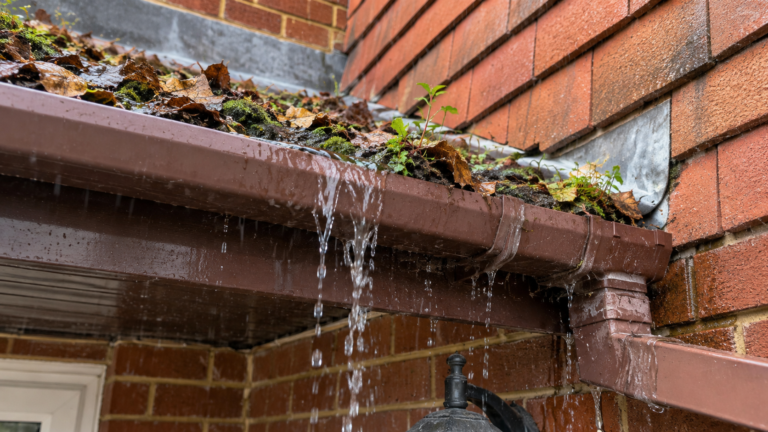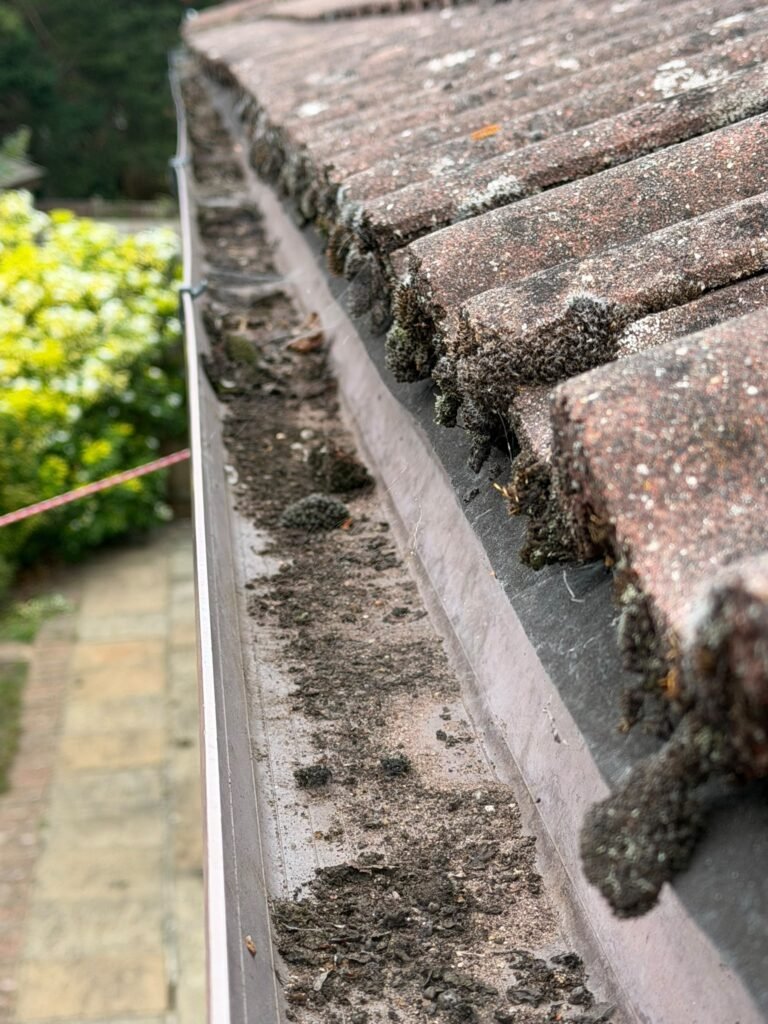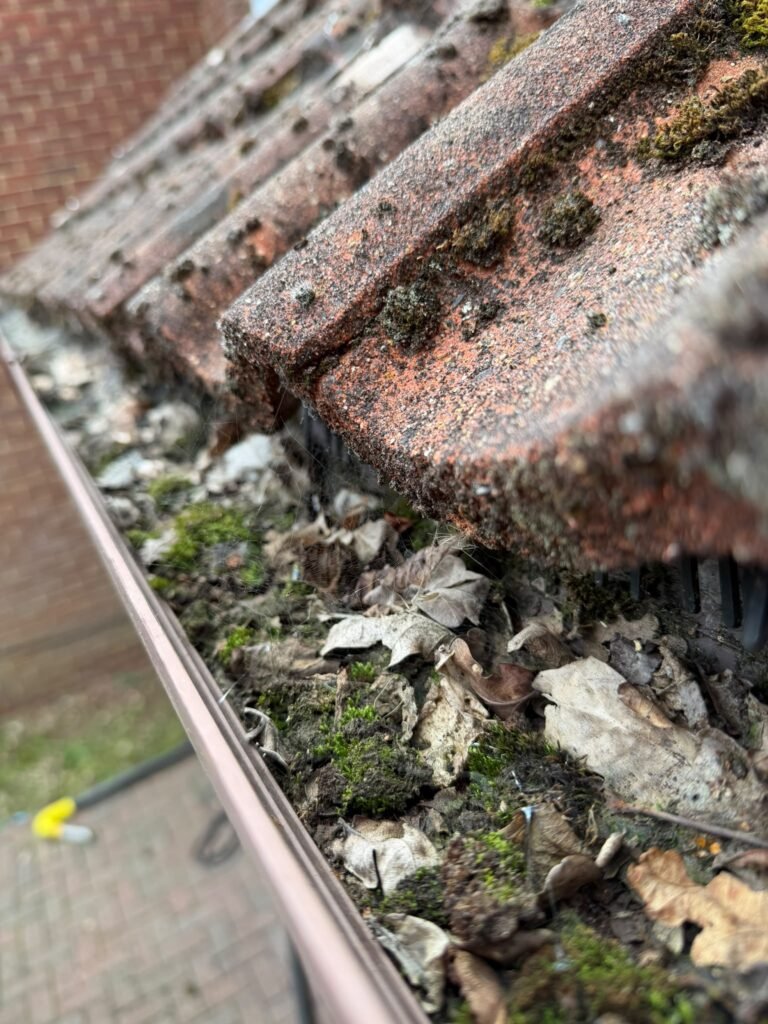
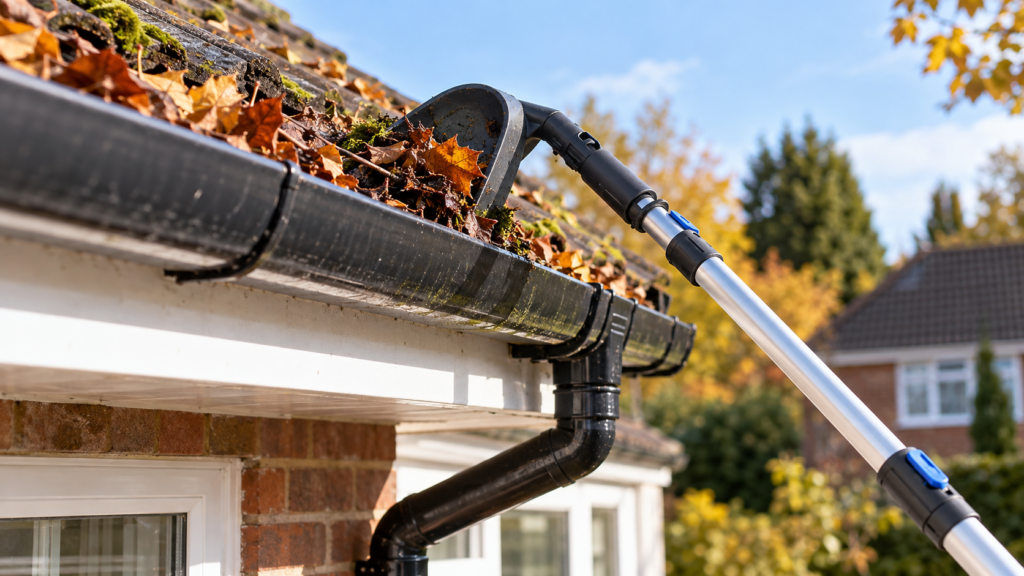
By November, gutters across the South East are holding a season of leaves, moss and roof grit. If they are not cleared before winter, rain spills over the front edge, runs down the walls and soaks the ground by your foundations. Our gutter cleaning service exists for homeowners who would rather not deal with this themselves, but plenty of people want to try first.
This guide covers how to clean gutters from the ground, which tool suits which kind of debris, and how to check the result without climbing up. It also covers the point where DIY stops being sensible. Ladder work gets one short section, because the safest clean is done from the ground.
What You Need to Clean Gutters From the Ground
You do not need everything here. Pick one main tool for your debris, then add the safety basics.
- A telescopic pole: the base for most ground-level kits, with a scoop, brush or hook head on the end.
- A gutter vacuum or wet and dry vacuum with a pole kit: lifts debris out instead of pushing it over the edge.
- A garden hose with a curved gutter wand: for flushing sludge and testing the flow afterwards.
- Gloves and eye protection: debris falls without warning when you work from below.
- Dust sheets or a tarpaulin: to protect paths, borders and anything parked nearby.
- A mirror on a pole or a phone on a selfie stick: so you can see inside the gutter without climbing.
Which Ground-Level Tool Suits Your Gutters?
Each method suits one kind of debris better than others. Check what is in your gutters before you buy or hire anything.
Telescopic Poles and Scoops
A pole with a scoop or claw head is the cheapest option and needs no power. It works on loose leaves and twigs, though it is hard to be precise from several metres below. Work in short sections and pull debris towards you rather than pushing it along the gutter, which tends to pack it into the downpipe.
Gutter Vacuums
A vacuum with a rigid pole is the cleanest ground-level method because the debris ends up in a drum instead of on your patio. It copes well with damp leaves, moss and silt. Which? notes that vacuums can struggle in tight gutter corners and in the swan neck at the top of a downpipe, so those spots often need a second pass with a hook or hose.
Hose and Pressure Washer Attachments
A curved wand on a garden hose loosens mud and sludge and shows you straight away whether water is flowing. Pressure washer gutter attachments clear packed debris faster, but they spray it onto walls, windows and anyone standing below. Older or brittle gutters can also be damaged by the force, so start at low pressure.
Leaf Blower Attachments
A blower with a long curved tube clears dry, loose leaves quickly. It does little once the debris is wet or matted, which in autumn is most of the time. Treat it as a quick tidy between proper cleans rather than the main method.
Step-by-Step: How to Clean Gutters Without a Ladder
These steps suit a bungalow or a standard two-storey house with clear ground below the gutters. Pick a dry, calm day, as a long pole is hard to control in wind.
- Look first: use your mirror or camera pole to see where the debris has built up, usually at corners, joints and above the downpipe.
- Protect the ground: lay sheets along the wall and move cars, bins and garden furniture out of the way.
- Clear the bulk: scoop or vacuum the loose material, working from the far end of each run towards the downpipe.
- Treat the corners: go back to corners and the downpipe outlet with a hook, brush or the hose wand.
- Flush the gutter: run the hose from the far end and watch where the water goes.
- Clear up: leaves and moss can go in the garden waste bin, and the rest goes with general waste.
How to Check Your Gutters Are Clear From the Ground
This step is easy to skip, and it matters most when you cannot see into the gutter. A gutter that looks empty from the lawn can still hold a band of silt or a blocked outlet. Use these checks before you put the tools away.
- The hose test: water should run along the gutter and out of the bottom of the downpipe. If it pools, overflows at a joint or backs up at the outlet, there is still a blockage.
- The camera check: a phone on a pole, set to record video, shows the inside of the gutter in a way you cannot see from the ground.
- The next downpour: stand outside during heavy rain and watch for water spilling over the front edge or dripping from joints.
- The walls below: fresh dark streaks, green growth or wet patches under a section of gutter point to water escaping there.
Clearing a Blocked Downpipe
If the gutter is clean but water still backs up, the blockage is in the downpipe. Clear what you can reach at the top first, then run the hose down the pipe from above using the curved wand. A drain rod or plumbing snake can help with a stubborn blockage, but do not force anything hard into the pipe.
Check the gully or drain at the bottom as well, as leaves often collect on the grid. Which? advises that a blockage below ground level is a job for a drainage specialist rather than a gutter cleaner. Overflowing gutters and wet walls are often the first sign of a downpipe problem.
If You Do Use a Ladder
Some gutters cannot be reached properly from the ground, and some homeowners prefer to see the job up close. If you go up, follow the basics that Ageas, Swiftcover and Which? all repeat.
- Set the angle: place the ladder at about 75 degrees, roughly one metre out at the base for every four metres of height.
- Use a stand-off: a stabiliser keeps the ladder off the gutter, which can crack under the weight.
- Keep your hands free: hang a bucket from the ladder with an S hook so you are not carrying anything.
- Do not overreach: climb down and move the ladder instead of leaning out.
- Leave the pressure washer on the ground: Which? notes that manufacturers advise against using one while on a ladder.
- Have someone with you: a second person can steady the ladder and call for help if needed.
When to Call a Professional
Ground-level tools have limits, and so does a ladder. Most household poles are made for bungalows and two-storey houses. Townhouses, loft conversions and houses on sloping plots are a different job, so it makes sense to hand it over if any of these apply.
- Height: the gutters are three storeys up, or the pole bends too much to control at full length.
- Access: the gutter sits above a conservatory, an extension roof or a narrow side passage.
- Heavy blockages: the gutter is full of compacted silt or plants have rooted in it.
- Signs of damage: sagging runs, leaking joints or damp patches on inside walls.
- The water still will not drain: you have cleared what you can see and the hose test still fails.
Trendline Window Cleaning Ltd is a fully insured limited company, founded in Croydon in 2021, and we look after more than 2,000 households across the South East. That includes homes around Redhill and Horley. If a clean leaves the gutters still not right, our 100% satisfaction guarantee means we come back for a free re-clean the same or the following day.
Gutters that overflow for a season usually leave green streaks and grime on the boards and walls below them. Our soffit, fascia and cladding wash deals with that once the gutters are flowing again. If you would like us to take a look, get in touch for a free quotation.