


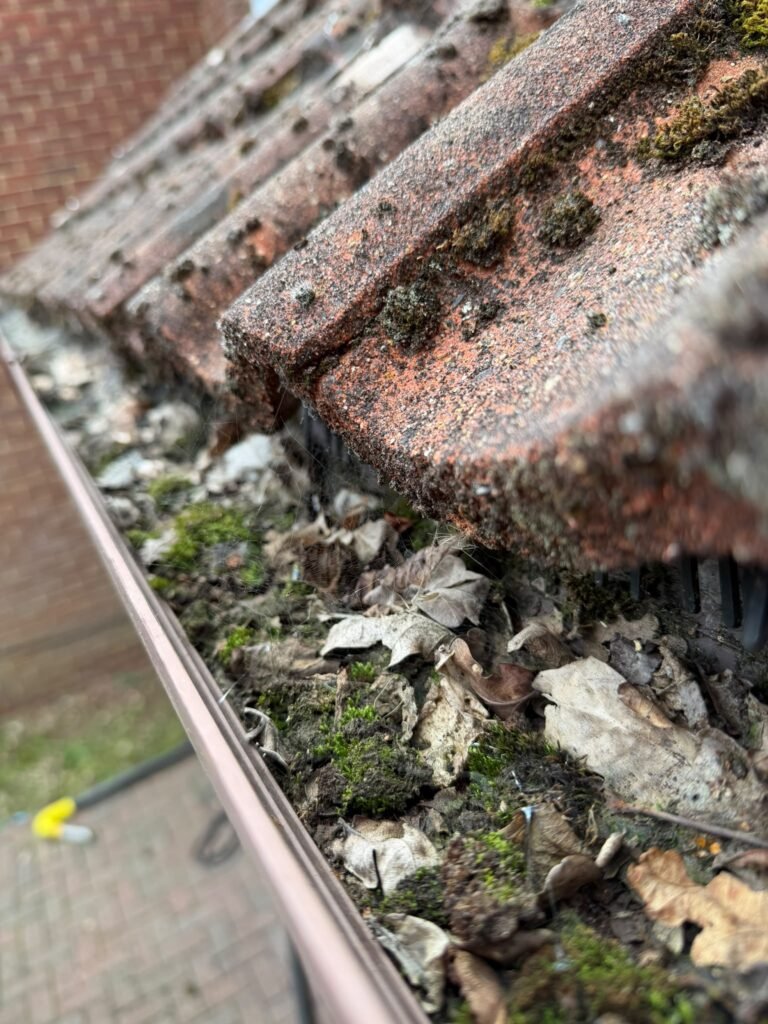
Most homes in the UK need their gutters cleaned at least twice a year: once in late autumn after the leaves have fallen, and once in spring. If your house sits under or close to trees, three or four cleans a year is more realistic.
That is the short answer. The right schedule for your home depends on what grows around it, the state of your roof and how exposed it is to wind and rain. This guide covers how often to clean, when to book, the signs your gutters can’t wait, and when to do it yourself or book a gutter cleaning service.
How Often Should Gutters Be Cleaned in the UK?
For a typical UK house, twice a year keeps gutters flowing. Leave them longer and leaves, moss and silt break down into a wet sludge. That sludge holds water, adds weight to the brackets and eventually sends rain over the edge instead of down the downpipe.
Twice a year: the baseline for most homes
A clean in late autumn removes the season’s leaf fall before the winter rain arrives. A second clean in spring clears what built up over winter: twigs, moss washed off the roof and grit from the tiles. For most semi-detached and detached homes with a few trees in the garden or street, that is enough.
When once a year is enough
Newer homes on open estates, with no trees nearby and a clean roof, can often go a full year between cleans. Book it for late autumn so the gutters go into winter clear. Even then, look up during heavy rain. If water is running over the edge rather than down the downpipe, don’t wait for the annual clean.
When you need three or four cleans a year
Trees that overhang the roof, especially oak, beech, sycamore and horse chestnut, can fill a gutter in a single autumn. Pine and other conifers drop needles all year, and these knit together into a mat that water can’t get through. A roof covered in moss feeds the gutters constantly too. In these cases, a clean every three months, or two visits in autumn plus one in spring, stops blockages building up between visits.
As a rough guide:
| Your home | How often to clean the gutters |
| Open site, no trees nearby, clean roof | Once a year, in late autumn |
| A few trees in the garden or street | Twice a year, late autumn and spring |
| Trees overhanging the roof | Three to four times a year |
| Pine or conifer trees nearby | Three to four times a year |
| Moss on the roof | At least twice a year |
| Flat roof, valley or box gutters | Check every three months |
When Is the Best Time of Year to Clean Gutters?
If you only clean once a year, make it late autumn. If you clean twice, add spring.
Late autumn, once the leaves are down
Clean too early and the gutters can fill up again within weeks. The best time is once most of the leaves near your home have come down, but before frosts set in.
Spring, to clear winter debris and moss
Winter storms blow twigs and litter into gutters, and wet weather loosens moss from the roof. A clean in March or early April clears this before birds start nesting and before summer downpours, which can overwhelm a half-blocked gutter in minutes.
Why winter is the worst time
Frozen debris is heavy and hard to shift, ladders are unsafe on icy ground, and water trapped behind a blockage can freeze, expand and split the joints. If a gutter is overflowing in winter, it is still worth clearing on a dry, frost-free day rather than leaving it until spring.
What Affects How Often Your Gutters Need Cleaning
Trees near the house
Trees are the biggest factor. Homes close to parks, commons and woodland, such as those near Knole Park in Sevenoaks or the commons in Chislehurst, get more leaf fall than most. One large tree a few metres from the roof can drop enough leaves to block a full run of guttering after a single windy night. Leaves are only part of it: seeds, blossom, catkins and the winged seeds from sycamores fill gutters in spring and early summer too.
Moss on the roof
Moss grows well on shaded and north-facing roofs. As it dries out, it lifts away from the tiles and gets washed into the gutter, where it sits like a sponge. If you can see green on your roof, expect your gutters to need cleaning more often.
Birds and nests
Pigeons, starlings and house sparrows nest in and around gutters and under roof tiles. Nesting material and droppings block the outlets. Under the Wildlife and Countryside Act 1981, the active nests of most wild birds are protected and have to be left until the young have flown, so the spring clean needs to happen before nesting starts.
Heavy rain and autumn storms
A gutter that copes with light rain can overflow in a heavy shower if it is half full. Storms also strip leaves early and blow debris in from neighbouring gardens. After a big autumn storm, check from the ground that water is running freely out of the downpipes.
Roof type and gutter shape
Flat roofs, valley gutters between two roof slopes and the box gutters found on some older properties collect debris more easily and are hard to see from the ground. These need checking more often than a standard gutter on a pitched roof.
Signs Your Gutters Need Cleaning Now
You don’t need to wait for a scheduled clean if you notice any of these:
- Water spilling over the edge in rain instead of running into the downpipe
- Little or no water coming out of the downpipe during heavy rain
- Grass, weeds or small plants growing out of the gutter
- A section that sags or has pulled away from the fascia board
- Damp patches on inside walls or ceilings near the eaves
- Green or dark streaks running down the outside walls
What Happens If You Leave Them Too Long
A blocked gutter sends rainwater where it shouldn’t go. Over months and years, that can lead to:
- Damp coming through external walls
- Rot in timber fascia boards and soffits
- Water pooling around the base of the house
- Brackets breaking under the weight of wet debris
- Stained brickwork and green algae on render
Clearing a gutter costs far less than fixing any of these.
DIY or Professional Gutter Cleaning?
If you live in a bungalow and have a stable ladder and someone to hold it, clearing the gutters yourself is possible. Wear gloves, scoop the debris out by hand working towards the downpipe, then run water along the gutter to check it flows.
For two and three-storey houses, it is a different job. Working at height on a ladder, reaching sideways with wet leaves underfoot, is where accidents happen. From a ladder it is also hard to see the full length of the gutter or spot a cracked joint.
We are a fully insured limited company, and all our work is covered by our 100% satisfaction guarantee. If you are not happy with the result, we come back and re-clean the same or following day, free of charge. See our gutter cleaning service for what is included.
Frequently Asked Questions
Do gutter guards mean I never need to clean my gutters?
No. Guards keep out larger leaves, but seeds, moss and fine debris still get through or build up on top. Brush-style guards in particular trap leaves that then have to be pulled out. Gutters with guards still need checking at least once a year.
Is it any different for a bungalow?
How often you clean depends on trees and your roof, not on the height of the house, so the same schedule applies. The difference is access: bungalow gutters are lower and easier to reach, which makes a quick check between cleans much simpler.
How can I tell if my gutters are blocked if I can’t see into them?
Watch them during heavy rain. Water running over the edge, dripping from the joints or not coming out of the downpipe all point to a blockage. Plants growing from the gutter are another clear sign.